Sunday, July 8, 2012

Doctor Who-Dalek War
                         In terms of DVD releases it's cases such as this where the continuity of Doctor Who gets somewhat murky. This set actually encompasses two separate third doctor era serials. Both are related to the other to a degree. But it is treated as one epic 12 part serial here because there is one connecting thread between the two of them. And that's the Daleks. In their last appearance on Doctor Who they were shown trying to manipulate peace on the planet Earth to their own advantage. But it had been quite awhile since we'd seen the Daleks matched up with their original adversaries the Thals. This also marked the every important first collaboration between the Daleks and the doctors other nemesis The Master. As such,this marks Robert Delgado's final appearance in the role he originated. Since these are actually two separate stories,I'll describe them as such.


                           In 'Frontier In Space' the TARDIS materializes inside a 26'th century Earth cargo ship in the middle of a very unpleasant situation. There is a conflict arising between Earth and a race called the Draconians. Both parties are perceiving that the other party is attacking them. Each time the doctor and Jo Grant appear to be the most likely culprits in elevating this conflict and are taken prisoner by humans. This eventually leads the doctor and Jo to be separated when he is sent to a penal colony for political prisoners upon learning the attacking Draconians are actually Ogorons using a hypnotic device to appear that way,in order to assure the conflict. Upon jury rigging an escape from the prison the Doctor learns the entire affair was orchestrated by The Master,who is trying to capture his opposing time lord to curry favor with those on Gallifrey. He is assisted not only by Ogorons but new companions the Daleks. During a conflict with them the Doctor is severely injured during the ensuing conflict with the Master. Before he loses consciousness he manages to send a message to his people about what is happening.


                     In 'Planet of The Daleks', Jo finds herself nursing an unconscious Doctor as the TARDIS is sent,apparently by the time lords to this jungle planet where Jo only finds plants that emit a sap like spray. Upon being hit by some of this she soon finds herself covered with a yellow fungus. And it's growing. After locating another derelict space craft further along she finds two humanoids who soon reveal themselves to be Thals.  They manage to find the Doctor,revive him and despite being skeptical of him being a now legendary figure in Thal lore,they explain the situation at hand. The planet is apparently called Spideron,where the natives are mostly sentient plant life. Including one who have the ability to make themselves invisible. The Spiderons themselves are being manipulated by the Daleks into helping them produce this. So the Thals, with advice and help from the Doctor and Joe manage to thrawt the Daleks operation against them with the Doctor again leaving the Thals with the message not to glamorize these events to others,and therefore war itself.


                Together these stories are an elaborate set of events that does form a strong epic flavor to them. Particularly in the final six part serial. The doctor helps the Thals to understand the importance of tactical cunning and the occasional necessity of armed conflict with the Daleks,who are again up to their usual heartless and amoral tricks as they attempt to exploit the abilities of the Spideron. Jo Grant,known for getting herself and the doctor in trouble by leaping before she looks,seems to have little choice in the matter in this episode due to the Doctor being incapacitated in the beginning. So this sometimes irksome quality of this character is perfectly justified here. Of course this would not be the last time the third doctor would encounter the Daleks before the end of his run. He only did so because,after all he spent a large part of this particular regeneration confined to Earth. But that's another story.

Friday, July 6, 2012

Doctor Who-Day Of The Daleks
                   Something changed about Doctor Who when Jon Pertwee took over the title role. The entire personality of the show changed,and it became quite a bit more popular. One of the things that defined this new and improved Doctor Who was not only that it was transmitted in color. But that the serials now emphasized it's sociopolitical themes a lot more strongly. Especially when the third doctor was confined to Earth working as the scientific adviser to UNIT HQ and Brigadier Lethbridge-Stewart. Therefore Terry Nation had a lot to worth with on this episode,which would be the first Dalek story for the third doctor. Historically this would also be the first time us in the audience would be seeing the Daleks in color so there was a lot to be excited about.


                  There's a vital peace conference occurring in the United Nations to prevent a third world war,which would use nuclear weapons. The doctor,Jo Grant and UNIT are called in when Stiles,a key delegate begins talking of ghosts at the country house where the conference is to be held. After staying the night to investigate the Doctor and Jo find themselves the captive of a group of guerrilla soldiers possessing a rudimentary time travel device and weapons from two centuries in Earth future. In a botched escape from them and menacing alien henchmen called Ogorons,Jo Grant winds up in the 22'nd century and it isn't long before the Doctor is disposed to go located her.


                Upon arriving he discovers that in the future,humanity has been enslaved by the Daleks,forced to work as slave labor for them aside from a select group of privileged human collaborators. They at first insist the guerrilla army that captured them were a deviant subgroup,when it turns out they are freedom fighters attempting to save humanity from the Daleks rule. Upon escaping with Joe and the help of sympathetic humans they learn that the Daleks were able to invade Earth easily after a war that ensued following Stiles' apparently failed peace conference. Upon returning to the 20'th century to set things right,the Doctor learns it's the freedom fighters who have created a paradox;that there time frame was created by their own botched attempt to save the conference. Luckily the doctor managed to get everyone out of the building and the conference back on track.

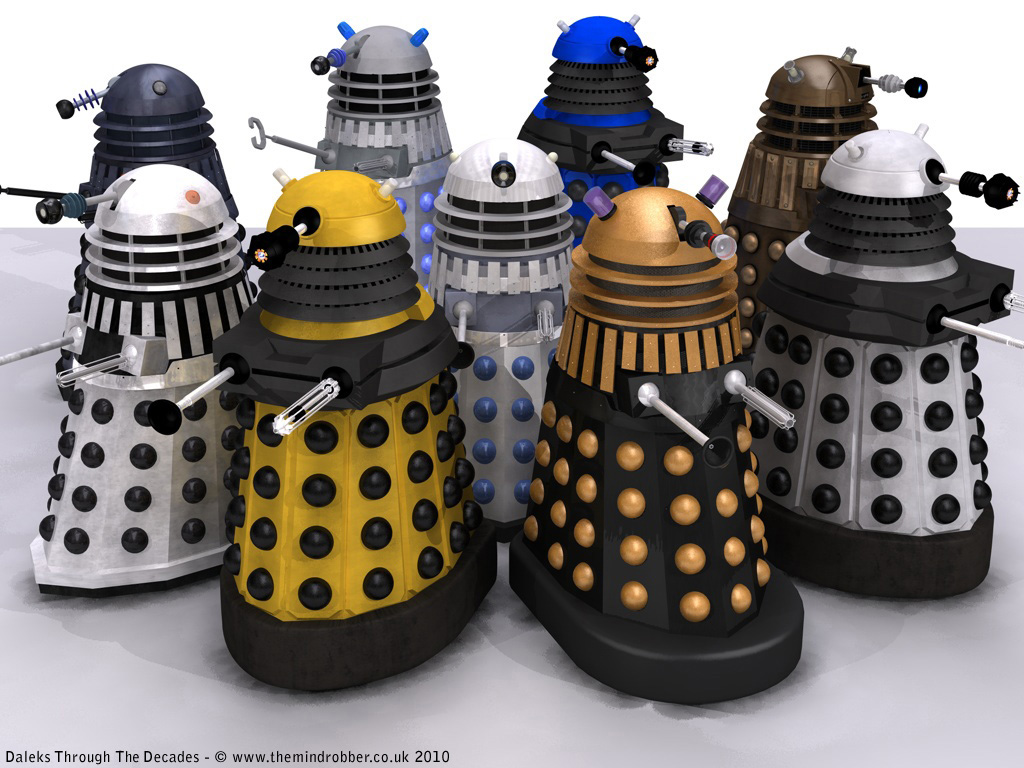
                True seeing the Daleks in color,especially the vivid mustard gold one is quite spectacular. In this episode Terry Nation also gives the Daleks a more living and complex flavor as well. Obviously always compared obviously to Nazi Germany in their goals and manner,the Daleks in this story behave more like very conscious soldiers of a totalitarian regime than unfeeling and partly robotic villains. With the collaborator relationship between the humans and Daleks in the future, the link between the Daleks and it's origins in despotic human behavior is cemented. This story has a lot of excellent action-adventure sequences with the Doctors Judo abilities and the confrontations between UNIT soldiers and Ogoron troops. But more over the plot of the serial more heavily emphasizes that strong political flavor of third doctor era Doctor Who. And considering the heated events on the real world stage at this point it couldn't have been more appropriate. 

Thursday, July 5, 2012

                            Doctor Who-Three Lost Dalek Stories
                          As many classic Whovians and Wholigans are aware,three classic series era Dalek serials are part of a collection of episodes missing due to the old BBC policy of recycling old video tapes. Therefore I have never had the privilege of seeing any of these serials needless to say. Nor has anyone else. But the original audio still exists for them all. And via YouTube many fans of the program have mixed still photographs and some of their own animations to recreated parts of these lost serials. It's a labor of love for sure. And I can only hope these three episodes will resurface somewhere and people cans see them as originally intended.


                         The first of these is the final William Hartnell Dalek story "The Daleks Master Plan". At a whopping 12 parts,this is the longest Doctor Who serial along with 'The War Games'  four years later.  Only three episodes of these serials-parts 2,5 and 10 are currently known to have survived. There's of course the late 1966 second doctor regeneration story 'The Power Of The Daleks'. This also introduces new companion Victoria. Due to the second doctor stories being the hardest hit in terms of missing episodes,this entire serial remains missing. The only other second doctor Dalek story 'The Evil Of The Daleks' fared only slightly better,with only the second part of the serial still being available.


                            I am sure there are better and more thorough fan reconstructions of these episodes. But I felt the ones you see here,constructed from some surviving footage,audio and in most cases still pictures will do the trick for now. Happily every Dalek story from the Jon Pertwee era of Doctor Who onward have survived intact and,as of August 10'th,2012 will all be available on DVD world wide. I am hoping one day,as was the case with the once legendary lost episode 'The Tomb Of The Cybermen' in 1991 that the three missing 60's era Dalek stories will be recovered in full for future generations to see.
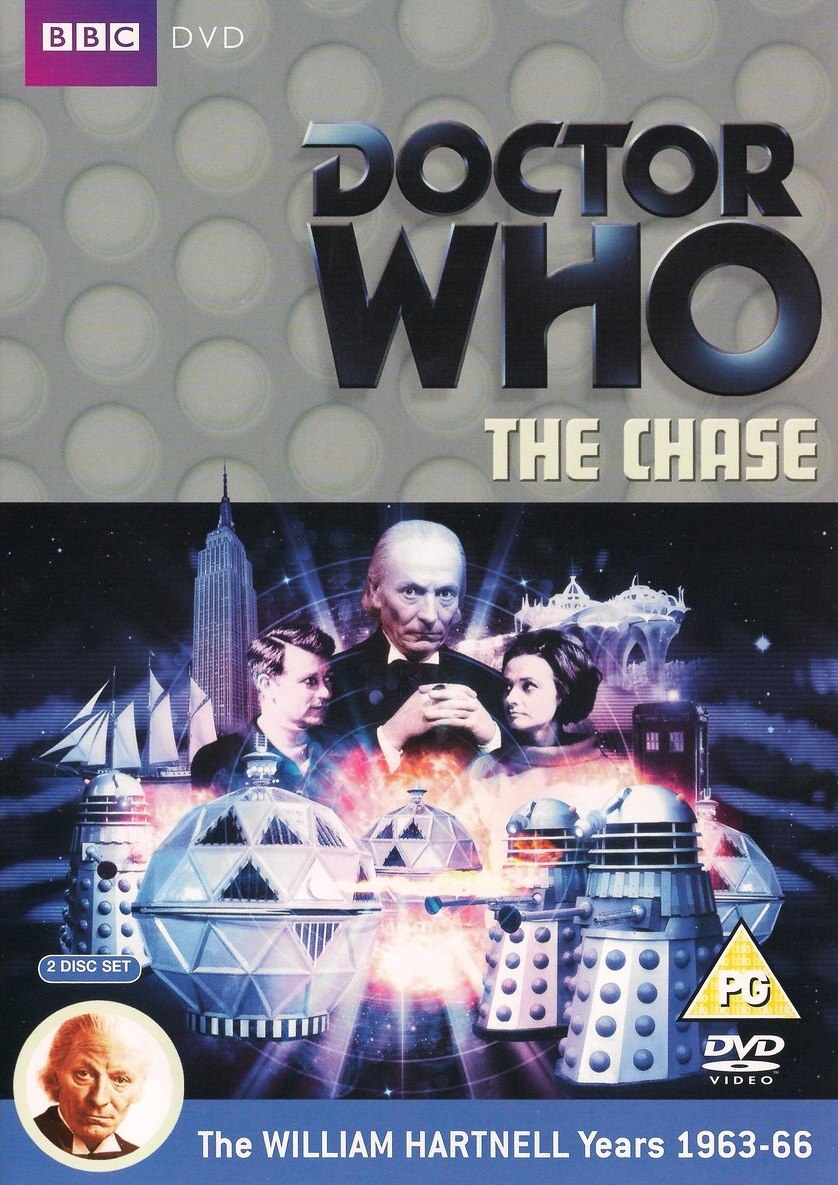
Doctor Who-The Chase
                             For anyone keeping score there were several first and second Doctor stories involving the Daleks that did not survive. This by the way is one of only three first doctor era stories involving the Daleks that has survived. Where at first the Daleks were probably considered as little more than bit characters for their debut,they quickly evolved into characters around whom rather epic stories were built around. This was one such story. In fact it was even quite a bit grander in scope than the previous Dalek story. Also as with the previous story this is an important historical story in the sense it also presents an exit for companions,in this case Ian and Barbara. 


                             In the beginning the doctor is trying to perfect a time-space viewer,sort of a television into history. After viewing into the doings of Abraham Lincoln and Shakespeare,Barbara catches notice of a group of Daleks on the prowl. The TARDIS had arrived in a mysterious desert planet and is now the "enemy time machine" to the Daleks. When Ian and Vicki go to investigate an underground tunnel they are menaced by creatures called Mire beasts. They have basically enslaved the humanoid natives called the Aridians,helpless creatures who soon come under orders from the Daleks as well to hand the doctor and his companions over to them as prisoners in return for the Aridian's safety from the Mire beasts. 


                                  After managing to escape to the TARDIS a chase through time ensues. First to mid 1960's New York where both the TARDIS crew and the Daleks confuse a befuddled tourist. After this a journey to what turns out to be a mid 1990's haunted house even the doctor believes is real. And from there, Barbara is almost taken in as a stowaway on the ill fated sailing ship Mary Celeste. The end up on the planet Mechanus and,after being menaced by giant fungi find themselves prisoners of the Mechanoids,spheroid robots who according to fellow prisoner Steven Taylor were sent by Earth to excavate the planet for human colonization. In the end the Mechanoids fight a losing battle with the Daleks,on both ends and while Taylor makes a noble sacrifice the doctor and his companions find themselves in possession of the Dalek's TARDIS. Ian and Barbara cease an opportunity to use it to return them home,much to the Doctors reluctance. In the end he and Vicki are sent out to wander time and space together.


                                   This represents some important firsts for Doctor Who. As presented in this six part serial,the Daleks are depicted as cunning and manipulative as well as hostile,even going so far as to fashion a robot Doctor who winds up dueling with the real one to his own end. They are not above using clever tricks to get their way in these episodes. The departure of Ian and Barbara at first has a different and profound effect on the Doctor than Susan Foreman's exit a year earlier. The Doctor is quite vocally disappointed at their wishes to depart him and needs prodding to help them do so. Upon viewing their return the Doctor,usually portrayed in this incarnation as mildly self involved,actually shows strong emotional attachment towards Ian and Barbara,vocally claiming to "miss them". Overall this serial represents an important evolutionary step in the series and the lead character himself

Wednesday, July 4, 2012

Doctor Who-The Dalek Invasion Of Earth
             With Doctor Who in the beginning of it's second series in 1964,it was felt there was a time for a change in the flow of the series. In the beginning the first Doctor's companions reflected the theme of the show as educational programming: two teachers and a (seemingly) teenage girl. But the nature of the program was changing. The settings for the stories were becoming more diverse and less set around historical themed serials or ones that were set in a future time. With the creation of the Daleks,and the concept the Doctor was not the only creature in the universe capable of space/time travel the program was on the verge of deeply broadening it's storytelling range. Further more this episode would wind up being the first ever farewell story for one of the Doctor's companions and perhaps the most pointed one at that.


             Upon the TARDIS arriving in London Ian and Barbara believe they have returned home. After some sleuthing on the part of Ian and the Doctor,it's found that this London is a wasteland in the mid 22'nd century. Earth has been invaded and the few humans left are planning a revolt,with others have been transformed into zombie like Robomen. It isn't long after this that the reason for all this chaos is found: a group of time travelling Daleks have invaded the Earth. It's up to the Doctor,his companions and the few remaining humans to keep the Daleks from bringing down re-enforcements and quell the infestation of the Robomen. In the meantime Susan has become smitten with one of the humans. And while in the end the Doctor successfully stops the Daleks invasion,he deliberately locks Susan out of the TARDIS,to allow her to grow and continue her adult romance with her human companion.

                It's this episode that concludes with the first doctors famous "Yes I shall come back" speech to Susan. It's a coming of age story for her character,as she is no longer as clingy to her grandfather and develops another type of relationship on her own. So on that front,again the soulless,aggressive Daleks create a set of circumstances that lead inevitably to Susan's departure. Not only does it allow her to have her independent love interest (the first time the idea of romance was strongly emphasized in the program) but the Dalek's planned conquest of Earth and it's view of the human race as utterly worthless on it's own strengthens that state of independence for Susan. With it's epic scope,compelling camera work and location shooting as well as that whole coming of age concept make this one of the major triumphs of the first doctor era serials.

Doctor Who-The Daleks

                             Following the very first Doctor Who serial,the program was perceived as educationally oriented with families in mind;something intelligent for adults and providing a lot to grow on for children. Because it's themes were based in history and science, it seemed almost impossible to be able to introduce any type of villainous characters to the show. For one that would've adopted the perceived cliche of B-movie type "rubber monsters" interfering with the programs more intelligent qualities. This posed a challenge to the shows writers and and producers to come up with an adversary for the doctor and his companions that provided as much insight as they did a genuine threat. Thus came the introduction of the Daleks.

                        Picking up where the debut serial left off the doctor, Ian,Barbara and Susan find themselves trapped on a planet high in radiation.  Using the ruse of the TARDIS's need for Mercury as a ruse to explore this planet they find a domed city and evidence of an atomic war. While exploring this city Barbara is the first to be tormented by an army tank like creature referring to itself as a Dalek. While off to the TARDIS to retrieve anti radiation drugs Susan encounters the Thals,a now pacifist race who had once fought a war with the people who eventually evolved into the Daleks. Upon meeting up with Ian,Barbara and the doctor it is Ian who convinces the Thals to set aside their pacifist ways to help defeat the cold blooded and merciless Daleks.

                          The completely militaristic Daleks are ideal adversaries for the doctor. And although they were primarily to have been for the first doctor,they remain the central villain of the program to this day. Why? Aside from their distinction,the Daleks provide an opening for many important sociopolitical points to be made. Ian,while describing the bigotry between the Thals and Daleks as "the dislike of the unlike" is also quick to remind the Thals that,as it was during the very real WWII,there are times when aggressive action is needed to thrawt an enemy that knows no compassion or mercy. As TV science fiction first notable hybrid of the biological and technological the Daleks provide the other characters a window into their own morality. Not to mention the Doctors own questionable act of endangering his companions for the sake of exploration. These factors alone make this a key part of the early years of Doctor Who.

Sunday, July 1, 2012

Dalek Month On Tardisriffic
                                        For many years one of the only things I knew about Doctor Who had to do with the Daleks. Even though I did not know them by name,they are one of science fiction's most famous villianous characters next to Darth Vader or the Borg on Star Trek. Introduced in the second serial of the series at the end of 1963 the Daleks introduced something very new to the world of televised sci fi: the concept of the merging of the biological and the technological. It would be massively influential as a science fiction concept for years to come.


                               Within the context of the program the Daleks backround story was as wibbly wobbly as time itself. Created on the planet Skaro after a milennia long war between the Thals and the Dalek's father race the Kaleds they were designed to be the idea soldier. A solider that would only kill or "EXTER-MIN-ATE" anyone who wasn't a Dalek. One orgin story had the Daleks created by a Doctor Mengele like figure named Davros,who created the Daleks to satisfy his on meglomania.  The Daleks,in the words of the Ninth Doctor are the ultimate vision of racial supremacy. And at a time when between Nazi Germany and the Cold War, that concept of the ultimate wielding of power was a very powerful one.


                                  This month I am going to be doing reviews of all the Doctor Who stories concerning the Daleks that I have seen. Important to note I am not fully versed on the relaunced series. And a lot of classic Dalek episodes from the first and second doctors era are missing along with many others. But that is going to be an overriding theme here on my Doctor Who blog this particular month. I also invite all readers to join this blog,subscribe and comment. I thought by concerning this month of blogging with one of Doctor Who's most famous elements it might give it a better chance at getting attention. Not to mention my own interest as well.