Thursday, May 31, 2012

 Doctor Who-Attack Of The Cybermen
             In late 1984 Doctor Who found itself in an unusual situation. For one thing,Colin Baker became the first doctor to appear in his own serial before the end of a season featuring the immediate predecessor. His debut story 'The Twin Dilemma' didn't fare very well with fans of the show. So when the sixth doctor began his first former season there were some changes. For one the stories would be two part serials for the reason,only 45 minute episodes in the nature. This would be the only time the original Doctor Who series would be produced that way. Also this story briefly found the doctor fixing the TARDIS's broken chameleon circuit. So this is the first time it actually appears as something other than a police box. Also it revitalizes the cybermen for the final time in the original series run.


            The TARDIS intercepts an alien signal originating in 1985 London. Once they arrive,in the same junk yard that the doctor original arrived on Earth in during 1963,the doctor and Peri find themselves intercepted by police officers on the trail of a man who turns out to be Lytton,former Dalek agent on Earth. He now seems to be involved with the cybermen,who are trying to commandeer the TARDIS to steal it's time/space travel secrets. Why? To divert Haley's Comet's course to impact Earth to prevent the destruction of their original home world. Upon arriving on the planet Telos,current home of the cybermen the doctor and Peri find themselves commandeered by the Kryon's,icy humanoids who were displaced from this world by the occupying cyberman. When the Kryon's realize that the doctor is on their side they use a special mineral to destroy Cyber control and liberate their world. But not before Lytton is killed after the doctor learns that Lytton was actually working with the Kryons against the cybermen.


           On the human end this is a well written story about the heroes journey. Lytton,looking to redeem himself after 'Resurrection Of The Daleks' is now working to prevent the destruction of Earth. And while the doctor is somewhat blinded by his mistrust of him and wish to stop the cybermen,he does in the end grad at his conscience in the end and realizes his mistake in judgement. This is fitting since at the beginning Peri is questioning the stability of the sixth doctors  personality. With his revelation of Lytton's mission,it winds up being a hero's journey for both of them. Only it's the doctor who gets to survive the tale of course. This is also the one time we see cybermen rejects,kept as prisoners on Telos.  The Kyron's are one of first female oriented aliens seen in this series. They have a wistful,lyrical manner of movement and speech that masks their noble ambitions. This story has many story elements,most of which represent the stories main points of redemption and freedom from mistrust.

Wednesday, May 30, 2012

Doctor Who-The Caves of Androzani
                       Following the 1983 special 'The Five Doctors',Peter Davison announced that he would be stepping down from his role as the renowned time lord for Gallifrey. Reasons were muriad,from the hectic work schedule to the advice of former doctor Patrick Troughton to remain with the program for only a few years. The fifth doctor represented an interesting departure for the science fiction serial. Still on it's shoe string budget the writers began adding more foreboding and series elements to the show. Part of that was producer John Nathan Turner's attempt to promote the show to more of an adult audience. All sorts of sociopolitical topics had always been at the core of Doctor Who's success. And since Peter Davison's fifth doctor always had a sense of vulnerability to him that wet well with the intense nature of some of his stories,this was explored in his final serial of the series.

                The TARDIS find the doctor and new companion Peri (Nicola Bryant) on the surface of a dead planet called Androzani minor. It isn't long into their scouting that they are captured and accused of being agents in a war between that world and Androzani major by General Chellak. An unknowing accident has caused the doctor and Perry to be infected by a fetal poisoning from the raw room of a revitalizing drug causing this war. It's called Spectrox toxemia. On Androzani Major, a man named Morgus is using this drug to extend his people's lifespan. The opposition is led by the vengence crazed Sharaz Jek,a brilliant cyberneticist who is forced to live like a monster after his former cohort Morgus betrayed and injured him. 

               While Sharaz first holds the doctor and Perry hostage,the doctor engineers an escape upon learning of a treatment for the poisoning killing him and Perry. During this time Chellak discovers that his subordinate Sebeteen has been one of the androids they've been fighting,while of course the Androids are part of a labor force designed to mine the deadly raw Spectrox. Once the doctor engineers the escape Sharaz Jek becomes aware that his seeming victory was another of Morgus's tricks and decides to help the doctor to redeem himself from his passion for vengence from his friend turned foe. In the end Morgus is caught,tries to escape with gunrunner Stotz and ends up dead along with Sharaz Jek. Sadly the doctor only managed to retrieve enough treatment for Perry and was forced to regenerate into his sixth incarnation.

            This story is one of the best Doctor Who ever did from the perspective of writing and even the shows occasional achilles heal in the FX department. The camera angles,lighting and color used reflect the tension in the plot wonderfully. It's a very thoughtful and serious tale about the political corruption that can result from one society benefiting from the suffering of another. This is a main cause,yet often unrealized,  of many wars. Morgus is every bit the crooked politician in this episode,never caring for anyone beyond his own needs and is willing to kill for it too. Sharaz Jek is one of the doctors most multi dimensional adversaries. At once ruthless,thoughtful and insane his motivations start out of revenge but end up in understanding. So he dies a hero as opposed to a villain. After this complex tale the doctor regenerates in his sixth incarnation,played by Colin Baker. This is the first time a new doctors image and name appear at the end of the credits since the first doctors regeneration. As the sixth doctor stated upon Peri asking him what had happened,"Change my dear. And it couldn't have happened a moment too soon".

Tuesday, May 29, 2012

Doctor Who-The Tomb Of The Cybermen
                         This is probably one of the 60's era Doctor Who serials that has a lot of historical value. It's the only surviving serial of the fifth season of the program in 1967. It's also the only one available featuring companion Victoria,who the doctor encountered in the missing episode 'The Evil Of The Daleks". This episode also reintroduced the Cybermen,who had appeared in the final (and also largely missing) William Hartnell era serial 'The Tenth Planet'. Unless one is a huge Whovian whose read the Target novelizations or listened to audio recordings this episode has some highly disrupted continuity. For most it's probably best taken somewhat as a stand alone episode as it can only function to look to the future of the show than towards a currently missing past.


                     While getting new companion Victoria acquainted with the TARDIS,they all land on the planet Telos,home of the cybermen where a team of human archaeologists have uncovered a massive facility with representations of cybermen all over it. Funded by a man named Kaftan and including Professor Parry,Eric Klieg and the taciturn servant Toberman the doctor and his companions join with the team,only to all find themselves in a massive cyber tomb. Surrounded by machines they don't fully understand the team,despite the doctors objections begin to fiddle with every control they find to understand it's purpose.  Pretty soon  they locate a frozen underground tunnel where they find a massive tomb of cybermen in stasis. Parry locks one part of the team inside to confront the revived cybermen.


                       Turns out Klieg and Parry have been in league all along so that Klieg could harness the power of cybermen to enact control over his people. On the other hand the cybermen have plans of their own. They decide to play Klieg and his Brotherhood Of Logicians,who seek physical might to back their intellectualism,against each other to assist the re-emerging of their own species. To the point of brainwashing Toberman to do their bidding. This is completed by the Cybermats,clockwork mouse like artificial lifeforms that disrupt human brain patters. As the doctor convinces Toberman of his humanity,Klieg and Parry play right into the cyberman's hands and perish accordingly. It's Toberman who seals the tomb at last at the cost of his own life as the TARDIS crew and the remainder of the expedition flee. Since only the body of Toberman and a single Cybermat remain,the future of the cybermen is unclear.


                        Not to mention being an important episode involving the nature of the cybermen, there are some important human themes dealt with here too. Of course there's the most obvious fact that Klieg's Brotherhood Of Logicians represented how a totalitarian mind is not dissimilar to a cold and uncaring cybernetically  enhanced life form such as the cybermen or even the computer that runs their facility. Most of the actors reflect this as well,except for George Roubicek's Captain Hooper,who seems to struggle with an apparently difficult American accent. There are also many important allusions to prejudice and emotional ties. Victoria at one point worries as to her family and the doctor gives her a kind and very fatherly pep talk about the advantages of free will.


                      Also considering the racially polarized times had Toberman,a black man depicted at first as a servant being liberated by the doctor after almost becoming enslaved by the cybermen. It's Toberman who becomes the noble hero of the piece by saving everyone's life at the cost of his own. These as well as the implied anti sexist message,with the female members of the expedition always treated as weak and vulnerable but resisting this impression. All this taken together is a a great counter balance between the 100% logic based world of the cybermen and the conflicts of human nature. Overall it's one of those Doctor Who serials that,due to it's claustrophobic settings and emphasis on dialog,that really explores the characters needs and motivations.
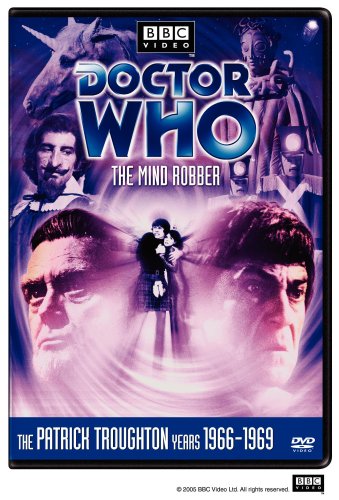
Doctor Who-The Mind Robber
                 Due to short sighted BBC policy Patrick Troughton's adventures as the second doctor remain  woefully unrepresented on DVD format. That is because only seven of his serials remain intact,in one case for the most part. The stories that remain available of his are luckily some of the best Doctor Who ever produced. And sometimes the most unusual. Considering the state of consciousness-altering late counterculture of the era,it was not surprising that this five part 1968 serial would openly embrace the concept of surrealism and the power of human imagination. Other science fiction shows such as Star Trek were also dealing with this concept at the time. And Doctor Who,as with that show managed to put it's own distinctive stamp on the concept.


                While sinking in a lava flow the doctor uses the TARDIS's emergency escape system to get himself,Jamie and Zoe out of danger. This pulls the TARDIS out of time and space all together and into a world where imagery,either fact or fiction from ones own mind could become reality. And even be used against them. There are friends such as Gulliver and a adversaries such as giant robots that come from no ones imagination. These robots presence lead the trio through a maze of fictional imagery intended to fool them,only to find it's all being run by a super computer who abducted a human from 20'th century England to do it's bidding with his vast writing skills.  In fact it wants to use the doctor,due to his immortality for the same purposes. After reversing this computers attempts to manipulate him and his two companions,the entire process is reversed and time and space are restored to normal.


                    Most stories on Doctor Who or most other shows over a clear bell shaped curve to them where one knows exactly what's happening. In this you never do. The imagery,from the TARDIS console flying through an ebony oblivion with Zoe and Jamie laying atop it to characters being randomly transformed into faceless cardboard cutouts is compelling. Especially for this period of the show.  Also there's an excellent implied message here. Dealing with a master computer who literally exercises it's ability to transform fact to fiction and vice versa,not only has the doctor met a match in terms of level of control but it calls to mind humans real life relationship with fiction. And that includes Doctor Who. Part of that implication is that the printed word,in a literal and figurative sense,can be used to enact great good or enormous turmoil to even one person alone. And that involves understanding the responsibility that comes from understanding the power of the human mind.

Monday, May 28, 2012

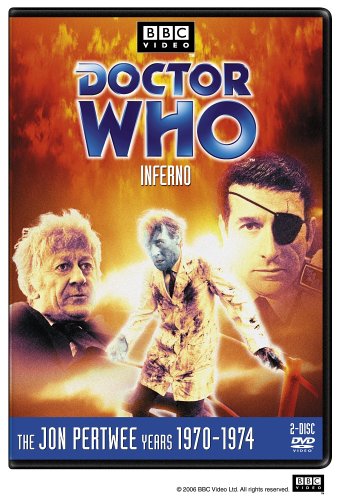
Doctor Who-Inferno
                     One of the important things that makes Doctor Who so interesting is the limited manner in which it has to handle it's limitlessness. It was a low budget BBC science fiction program whose central character could travel anywhere in space and time. In a way these two qualities ended up being complimentary and giving the show it's distinctive flavor. It also continues in the shows seventh season tradition of delivering on stories that blended terrestrially based monsters with pointed sociopolitical commentary. Since the doctor was exiled on Earth in the early Jon Pertwee years,the opportunity for this type of storytelling was boundless. There was also an interesting little gizmo thrown into this story that made it equally interesting. Main actors Nicholas Courtney,Caroline John and Stewart Levene  actually get a chance to play the duel side of their roles in this episode. The reason being is that a central element of this story has to do with what has today been somewhat childishly renamed the multiverse theory.


                  Professor Stalman (Olaf Pooley) is heading up something known as Project Inferno,an attempt to drill into the Earth's core for a nearly inexhaustible energy source. Meanwhile many of the people involved are experiencing unusual mutations. UNIT and the doctor are called in to investigate but it's soon apparent the Professor's erratic behavior is part of the same symptom. The concept of drilling to the Earth's core is proving controversial. Same for the doctors plans to use the projects nuclear reactor to restore the functioning of his TARDIS. On his second attempt to do so he finds himself in a despotic parallel universe and a run in with dictatorial alternate version of Lethbridge Stewart and his companion Liz Shaw. They are undergoing the same experiment in this universe. But despite the doctors attempt to tell them he's not a spy,their Earth is destroyed by the successful tapping of the Earth's core and the resulting lava flow. This energy allows the doctor to return to his universe in the TARDIS to warn them on ending the ill conceived project in time.


               This is one of the most intense,edgy and even stressful of the original Doctor Who serials. While at first following a similar plot line to other Pertwee era stories dealing with corporate short sightedness,particularly involving nuclear power the real captivating parts of this serial occur during the fourth,fifth and sixth episodes which take place almost solely in a parallel reality. Liz Shaw is portrayed here as a prisoner of her worlds dichotomy,which seems to indicate the up rise of some kind of British version of the Stalin era communist party or even Nazism. Lethbridge Stewart on the other hand is portrayed similarly to his counterpart only more dramatically aggressive and with self centered motivations rather than the generally selfless ones of the Brigadier. Seeing Nicholas Courtney sans moustache and plus eye patch and scars is worth it alone. It's also a reminder perhaps of the dark and light sides of each person's personality,personified here in different universes. One of the strongest and most shocking perhaps of Jon Pertwee era Doctor Who episodes.
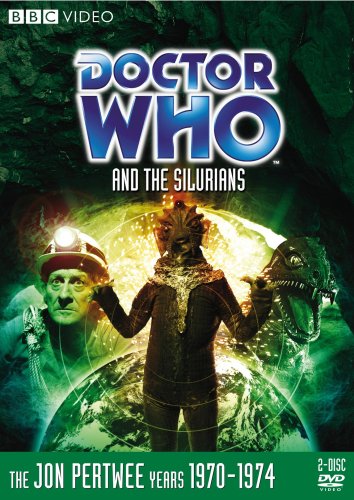
Doctor Who And The Silurians
                Even as early as this second serial starring Jon Pertwee there was a concentrated effort to give Doctor Who a somewhat more topical edge. The program always reveled almost in it's efforts to make it's low budget rubber monsters and blue screen effects seem as genuine as possible. No one ever intended it to come off as exploitative. And this is a good example of an episode that managed to accomplish melding that low budget flavor with that flare for social and scientific commentary pretty successfully. It also began the tradition of the third doctor era of serials often being six or seven parts in nature. I've heard this was due to writers strikes at the BBC and such that limited the amount of stories they had for a season. And the programs seventh season,Pertwee's first on the show was in fact incredibly short with only four mostly very long serials. Even though one of them is not yet available,these are all excellent stories and all key contributions to the world of Doctor Who.


              What happens here is that underground workers for an experimental nuclear power facility are beginning to exhibit paranoid behavior,one even bought to making cave drawings on the walls of his hospital room. UNIT are bought in to investigate including the Brigadier, Sgt. Benton,Liz Shaw and the Doctor. The projects Director Lawrence tries to block the investigation at every turn. And pretty soon even his closest allies such as Dr.Quinn begin to experience trouble and Quinn is eventually killed. Why? As the doctor discovers during his investigation it's by an advanced underground race called the Silurians,who lived during that era of Earth's history. They miscalculated a planetary disaster and awoke from hibernation still believe the Earth to be there's. While the doctor is convinced the Silurians can be reasoned with the Brigadier and Lawrence are caught between destroying the creatures for safety reasons and Lawrence using them to gain access to their superior technology.


             The Silurians become aware of this,capture members of both UNIT and the project,and eventually conclude that humans have become an infestation on their world to be wiped out. So they develop a fast acting viral infection that,once released via a released prisoner,begins to cause an epidemic on the surface. As members of UNIT,the project and even the general public begin to die from this biological warfare agent the tensions even between Director Lawrence,UNIT and the public comes to a fevered pitch. The doctor and Liz Shaw race for a cure but by the time they finally find it, the Silurians have murdered their own leader due to his acceptance of the Doctors suggestion they learn to live with humans who they few as invading primates. In the end the Brigadier ends up being forced to answer to higher powers as the Doctor and Liz are forced to watch the Silurian race be destroyed by UNIT without any chance of a negotiated peace.


              Personally I find a consistent theme,particularly in the Jon Pertwee era,of Doctor Who is that of militaristic short sightedness versus scientific reality. It's the age old argument between aggression and reason. Even though the third doctor and the Brigadier are depicted as being very much at odds in terms of opinion in these early years,you can sense Lethbridge-Stewart is often the man caught in the middle. He inherently trusts the doctors judgement but being a career military man ends up always having to act out his strong sense of duty.  In the end it's the balanced personality of Liz Shaw who often provides the voice of reason. Considering the doctor is perceived as a lunatic by many self centered humans and the Brigadier as a naive meddler.  Themes of sociopolitical inefficiency,biological warfare as well as racial prejudice and fear abound in this story. The Silurians are depicted as an advanced but confused race,some willing to exist peaceably with Earth's new inhabitants with others willing to kill for their dominance. These elements taken together are part of what make this such a compelling story.

Friday, May 25, 2012

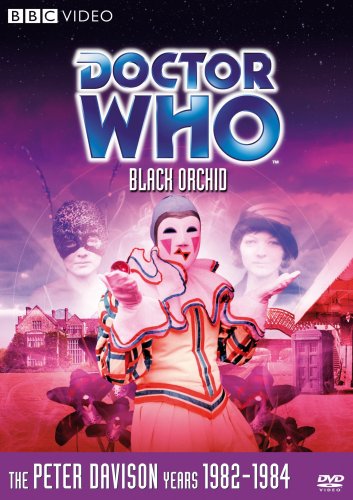
Doctor Who-Black Orchid
                 Since the earliest stories on this program featuring William Hartnell and Patrick Troughton the producers of had generally avoided any overtly historical serials.  While a good deal of Tom Baker's stories featured historical settings,the stories were usually very fictionalized and purely fantasy based.This  avoidance could  have something to do with a belief that somehow those type of shows were linked to Doctor Who's perception as a disposable children's program and to why so many master tapes for the episodes were erased in the 70's. The Peter Davison era of the show actually revived that concept to a degree. Especially when it came to the additional face that each season of the fifth doctor era had one two episode serial in it. This is the first of them,from Davison's first year. It's also the first terrestrially based historical episodes of the show made in a very long time.


                  The TARDIS starts by arriving in a London train station in the summer of 1925,only to be picked up the chauffeur of Lord Cranleigh,who is said to be expecting the doctor for a cricket match. Dressed for the part,the doctor does well and he,Tegan,Adric and Nyssa are invited to a fancy dress ball. Especially when Nyssa is found to be the spitting image of the Lord's fiancee. During dinner and dancing in which the two physically identical ladies pull a switch the doctors curiosity peaks him to go scouting where he encounters a dead body. Seems some in the family are trying to hide that the servants at Cranleigh manner are being murdered. As the fiancee is injured by an unknown assailant dressed in the doctors harlequin costume for the ball and as the befuddled authorities struggle for proof of doctors identity to solve the murders,this makes the doctor and his companions suspects in the murder and motivates him to solve the mystery.


                 This compact serial is an excellent whodunit  type episode with a good deal of comedy involved too. It's a fun episode to watch too. In particular with it's vivid and colorful location shoots for Cranleigh Manor in the Edwardian era and the cricket field Typically Adric's main interest in the serial is filling his face with food,much to the amusement of the other companions. For her part Janet Fielding gets to have a lot of fun as Tegan,dressing up in 1920's garb and dancing the Charleston. Sarah Sutton does wonderfully in the duel role of Nyssa and Ann Talbot,who both become pawns in a mystery involving a black orchid from which the episodes name is obviously taken and a missing brother betrothed to Talbot. It's a fun,interesting,colorful and extremely well paced mystery type Doctor Who serial that the viewer will likely keep their eye on to the very end.