Monday, July 30, 2012

Why No Reviews For The Modern Dalek Shows?
              I have to admit that I've really only been deeply involved in Doctor Who for less than a year now. But as with most things,when I first become interested in anything I immerse myself very heavily into it. So far I concentrated primarily on the classic Doctor Who episodes from 1963 through 1989 in terms of this blog.


        Because I have only explored the ninth doctor episodes involving Christopher Eccleston,I felt it would be wise to wait until next year at some point to have a "Dalek week" at which time I'd concentrate on the Dalek episodes of the current version of Doctor Who I've just recently began getting into. What's next up on the agenda for this blog? Well all you have to do is guess which actor who played the doctor is having a birthday in the coming month.
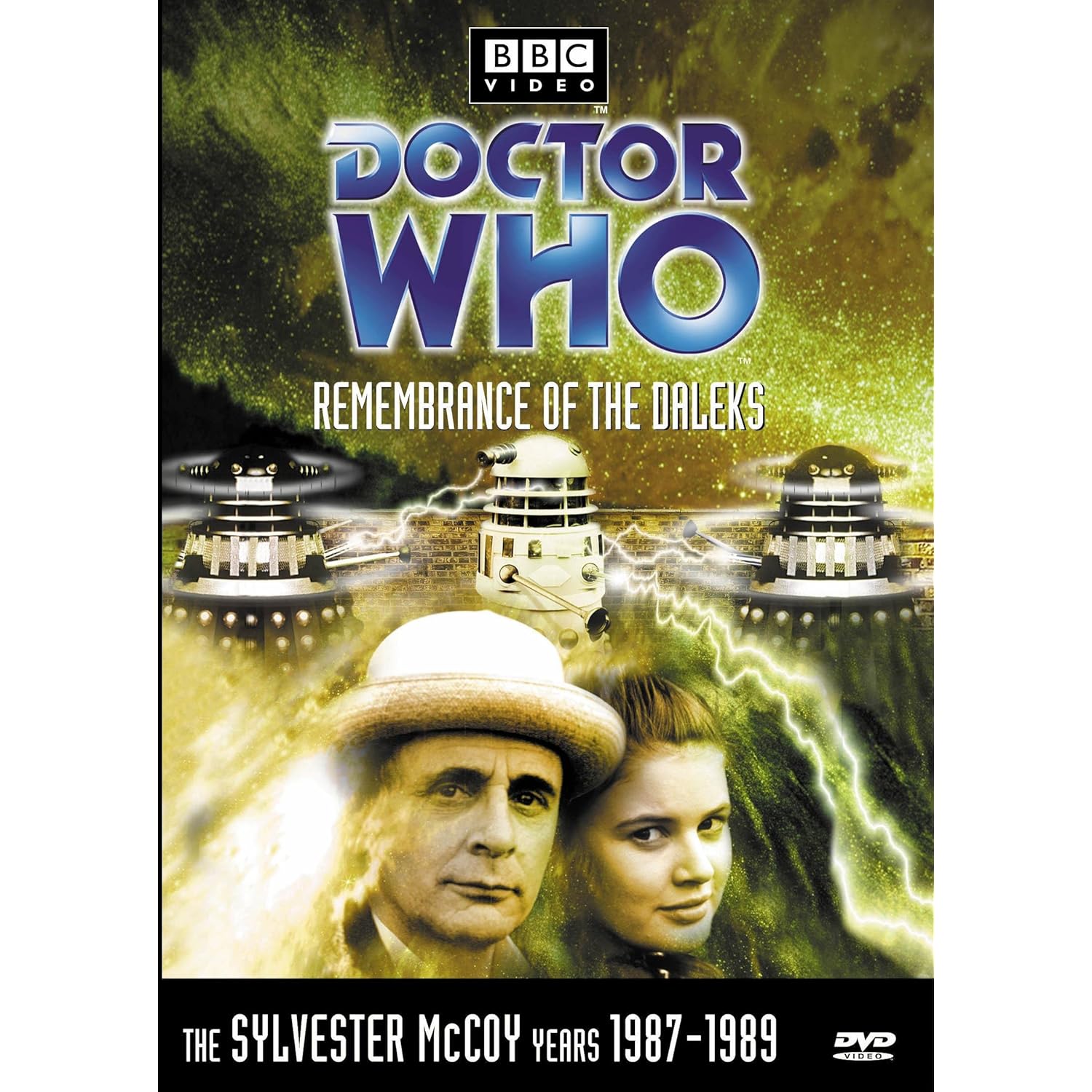
Doctor Who-Remembrance Of The Daleks
                    By the time 1988 rolled around Doctor Who was basically on it's last legs. Today a lot of people agree that the program had begun to steadily improve during the second series of Sylvester McCoy's tenure as the seventh doctor with Sophie Aldred as companion Ace. But no writer or producer could turn the tide of public opinion. So it was up to producer John Nathan Turner to try to bring some enthusiasm back to the show as he'd been looking to do most of the 1980's. Considering the decades penchant for cultural nostalgia that seemed like a good way to go for this new serial. So not only were the stalwart villain the Daleks bought back into the series, but there was also a return to an all too familiar setting.


                      The TARDIS arrives on Earth near Totters Lane junk yard,not too far from where the first doctor had originally departed,a few days after he'd done so in the year 1963. They find the military converging on a magnetic disturbance. The troops are attacked by an unknown assailant who turns out to be a grey Dalek. Turns out the Daleks have come to Earth to find the Doctors Hand Of Omega,the time lords key to space time travel. The Daleks are controlling a local fascist group in order to secure this. The doctor decides to "bury the past" at a very unusual funereal ceremony.  A Dalek vessel is dispatched to Earth to locate these Dalek renegades to their Emperor who is Davros seeking the Omega Device. After a cat and mouse game the Dalek mother ship is destroyed and the threat diminished.


                     Even though this represents the final Dalek story of Doctor Who's original 23 year run, there was also another undercurrent  in this story. The Daleks have an extremely fascist attitude towards other races. On the other hand,Ace's disgust at a "No Coloureds" sign she sees in a window is an important reminder of an unfortunate tendency humans and Daleks seem to have in common during this time period. There's also a little reference to the well documented self promotion of John Nathan turner as,upon Ace leaving the room in the same scene,the theme for the William Hartnell era 'Doctor Who' is seen on a television set behind her. Not only is this a good example of the quirky wit of this program,never above breaking the fourth wall but an excellent send off to the Daleks for the classic series.

Saturday, July 28, 2012

Doctor Who-Revelation Of The Daleks
                         Colin Baker's tenure as the sixth doctor would be the shortest lived of the classic series,with only seven proper serials before the series was actually (and luckily temporarily) cancelled. Considering the bad reputation the program was getting at the BBC during 1985 from all sides,from censors to the public itself,it was lucky Doctor Who survived through it at all. Fact is,Colin Baker was scapegoated in terms of being an easy target for why the series was failing. None of the writers and producers at the time were willing to accept any blame for this as they scrambled to retool the show to go over better with the public. Again writer Eric Seward came to the conclusion that the best way to handle this would be to haul forth one of Doctor Who's most reliable old standbys,the Daleks as inspiration for a new serial to try to revive interest.


                     The Doctor and Peri are on the planet Necros where the doctor is planning to contact a scientist acquaintance of his. While there they are attacked by a mutant creature Peri is forced to kill to save the doctor. Then they discover a mysterious stone statue of himself that falls and almost kills him. This all turns out to be related to strange goings on at a fanciful looking funereal home called Tranquil Repose,whose egoist director Jobel and his staff have been putting the dead into suspended animation. Once the curious Doctor and Peri enter the facility they meet up with Natasha and Grigory,who have become suspicious when they find one of the suspended animation capsule that the the man both them and the Doctor were there to see was empty. Soon they discover the man they are looking for,partially transformed into a Dalek. Turns out that the funereal home has come under the control of the Great Healer who turns out to be none other than Davros,to whom Jobel has become something of a pawn.
      
                 They are all informed the brains of the deceased are being used to create new Dalek mutants. This creates discord and violence among the already tense and sometimes traitorous staff who begin battling each other. Meanwhile the Doctor and Peri are led by Jobel to meet a DJ with an American accent,whose been playing songs and informing those in hibernation of current events while privately reflecting that cures for their ailments were developed years before,due to him reminding Peri of her home. Turns out the DJ himself wishes to liberate the deceased from the Great Healer from the inside. During this time the Doctor asks Peri to return to the TARDIS to hail the planetary president,en route to Necros with the body of the first lady of Davros' plan. The DJ offers his own equipment to make the transmission which is intercepted by Davros who then kills the DJ and captures Peri. In the end Dalek factions loyal to the Dalek supreme and to Davros battle it out. The grey Daleks,loyal to Skaro win and return take Davros to his home planet to stand trial. However in addition to the DJ Jobel's own deceptions have resulted in his death as well.


            This serial is one of the most complex and elaborately written Dalek stories ever. For all intents and purposes Davros has become something of a carnivorous character,in desperation doing so far as to use the brains of the dead to create new Dalek mutants. A lot of the action also revolves around the vain and pompous Jobel, who meets with an unfortunate end do to his own personally conniving ways. One of those most intriguing characters here is the unnamed DJ character. Existing in a warped psychedelic world of sped up oldies and hip Murry The K like lingo he reinforces the concept of the DJ on Earth as an implicit force for social activism,often delivering important messages throughout the story in code. Even before Peri meets up with him,it's easy to become sympathetic with the character you want to be the good guy. And he is. Even perfectly willing to die for the cause. Because the show was temporarily cancelled however,the final scene was clipped off because it referenced an already written episode that would not be produced. But even though the sixth doctor era was about to end,Doctor Who was not over and neither were the Daleks.

Friday, July 27, 2012

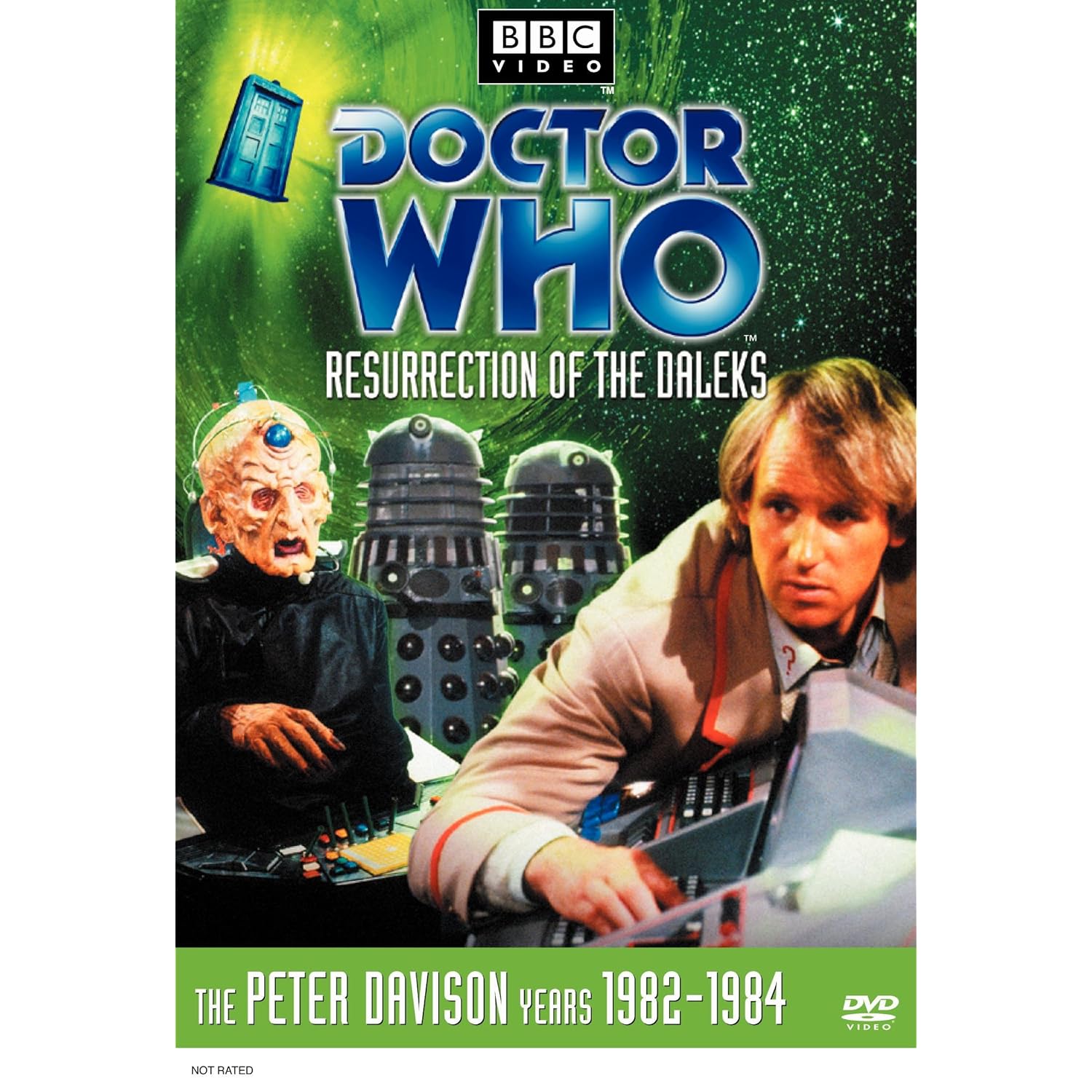
Doctor Who-Resurrection Of The Daleks
                   By the time this serial was produced Peter Davison had already announced his departure from Doctor Who. At the same time Davison himself pointed out he didn't feel he could leave the show without facing down his greatest adversaries the Daleks at least once. That was something the fifth doctor had not yet done. At the same time there would only be two more serials to feature the fifth doctor after this anyway. And in between that time there'd be a a couple departures and one new addition to the cast. In this serial the first of these departures occurred with Janet Fielding's Tegan at the conclusion of this serial.


                   The TARDIS sets down in a London alley where a group of futuristic people are being pursued by a police force led by one Commander Lytton. He than transports to a prison space station whose sole occupant is Davros himself. He is in the process of being revived by the Daleks who lost their war with the Movellans. And they are attempting clone the doctor,his companions and any humans involved to join their cause. From this point on it's one blood bath after another involving the Daleks,running in and out of the time corridor that bought the TARDIS there until the Daleks are again defeated. Only having to play witness to these events,a traumatized Tegan elects to leave the TARDIS crew being weary of the mass death she'd witnessed.


                     This serial is probably the most violent and gruesome of the classic series Dalek stories. More than half the characters in the beginning parts of the serial are dead and lethally injured by the time the serial comes to a completion. It was probably this intense level of violence that led many to complain of Doctor Who becoming too violent for it's family audience. There are some excellent scenes,especially where the Doctor tries yet another time to reason with Davros about the futility of his mission. As well as Tegan's emotionally charged farewell. In the end this serial would somewhat set the tone for the more aggressive nature of the next doctors stories.

Thursday, July 12, 2012

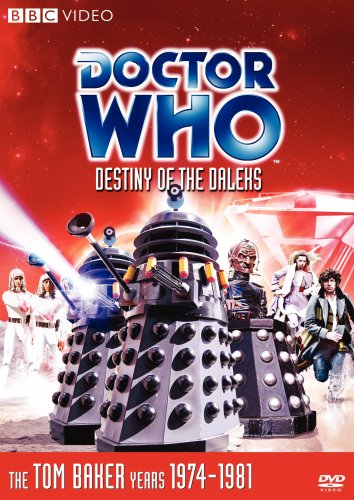
Doctor Who-Destiny Of The Daleks
                      It had been five years since there had been any Dalek based stories on Doctor Who. The Tom Baker era of the program had developed it's own distinctive flavor,more oriented around gothic horror type plot lines than a lot of overt science fiction. Perhaps that is one of the reasons why the program was so successful during this time. On the other hand the season long 'Key To Time' series of serials proved that more purely science fiction plotlines in Tom Baker era Doctor Who could definitely work extremely well. This was also a regeneration story. Not of the doctor but of his time lady assistant Romana. From this point on that character would be played by Lalah Ward,whose close relationship with the Doctor would spill over into their personal lives as well.


                       The serial starts with the doctor attempting to repair a damaged K-9 while Romana regenerates into the form of Princess Astra from the previous set of serials. The TARDIS lands on a rocky,radioactive planet that is soon understood to be Skaro. While trying to explore the area,Romana and the doctor are separated at which time she finds herself menaced by a pair of Daleks. The doctor meanwhile is rescued by a group of silver haired humanoids called Movellans,whose apparent mission to defeat their enemy Daleks is at first somewhat appealing to the Doctor. Meanwhile the Daleks are attempting to revive Davros,now in suspended animation to help fight this battle. The Doctor soon learns the Movellans are in fact ful androids bent on total destruction of the Daleks at all costs. In the end,Davros is placed back into cryogenic sleep again and sent to Earth to stand trial for his crimes. But not until the Doctor leaves the logic bound Movellans with a little lesson about the fate of those who makes mistakes in war.


                     While a somewhat quirky anti war story for sure,this serial introduces an unusual new wrinkle into Doctor Who. We're never sure if the Movellans are a hindrance or an asset. Especially as they often behave no better than the Daleks,often worse. On the other hand a hats off to the wardrobe department whose glittery suits,silver braids and platform shoes gave the Movellans a funky late 70's look rather like a race of alien robot Rick James clones. In her first appearance Lalah Ward makes an excellent first impression as Romana. She comes off as elegant,intelligent and highly observant. While definitely a serious episode in terms of it's content,it does showcase some of the humor that would define this season of the fourth doctor. This is showcased strongly in a rock/paper/scissors game the doctor plays with the Movellans to show them the futility of war time aggression. While it's mixture of quirkiness,wit and sociopolitical commentary this is a very compelling final Dalek story for the Tom Baker era.
Doctor Who-Genesis Of The Daleks
          Since their introduction over a decade before this particular serial was made the Daleks were presented by and large as a catalyst for the Doctor to interact with other characters,usually another race the Daleks were exploiting. Their history had not been fully explored since they were first introduced. Though the Thals and the planet Skaro had in fact been part of other Dalek related serials before,there were still a lot of questions that fans of the program probably had. How exactly had the Kaleds evolved into the Daleks? Why was it allowed to happen? And was their a single focal point,either a group or individual,who were directly involved with their creation. Well the fourth doctor,Sarah Janes and Harry Sullivan had by this point proved themselves already one of the most popular doctor/companion combinations that Terry Nation almost outdid himself by providing this-the first and probably most compelling and provocative Dalek stories of the Tom Baker era.

         The Doctor,Sarah and Harry are sent sans the TARDIS to Skaro during their thousand years war by the time lords in order to discover a way to keep the highly destructive Daleks from coming into existence. Given a time ring as the only means of returning the TARDIS crew find themselves in the middle of a poison gas attack and dragged into the Kaled dome,with the exception of Sarah. The Kaleds are planning a massive offensive against their enemies the Thals,the Kaleds viewing themselves as the superior race. They confiscate the time ring. The doctor also meets up with a Kaled mutant calling himself Davros,who is in large of developing this last offensive. It comes in the form a mechanical hybrid of Kaled mutants he calls...Daleks. And in an attempt to recapture it the doctor is placed under arrest and questioned by a Kaled scientist. This scientist himself understands the Daleks are a dreadful and terrible weapon and for helping the doctor escape he himself is killed by orders of Davros.

        Meanwhile Sarah has befriended a group of Mutos,mutated Kaleds and Thals who have learned of a final massive strike on the part of the Thals against the Kaleds that would wipe out their dome. The doctor meanwhile is in the midst of a three prong conflict. First the one was Davros,who openly shows no compunction for wiping out a species in any manner necessary to suit his need for absolute power,his manipulative Security Commander Nyder who presses himself to divide and conquer anyone around him and his main mission. He is in fact given one opportunity to bomb the Dalek lab. But ethically he is troubled by the possibility of himself committing what amounts to an act of racial genocide. In the end of the story the Kaled dome is destroyed,even with Sarah and the Mutos best efforts to stop the attack. And even though they essentially failed in their mission,they do relocate the time ring and  it's made clear that the doctor feels a completely clean conscience in his decision.

          This is probably the most well rounded and morally complex Dalek story ever written. This is the one moment where the doctor is given the opportunity,in one famous scene,to destroy the Daleks before they come to exist with a mere simple bomb. His contention that many species throughout the universe would unite together in peace in defience of the Daleks seems very much motivated by his knowledge that Davros (and many of his Kaled supporters) have become such megalomaniacs they no longer place any value in life aside from themselves. You also see the divisions within the Kaleds,which is very much parallel to the real life gap between scientists and militarists. The Kaled scientists are mostly concerned Davros has gone too far in his creating the emotionless Daleks and unite against him after a time. We are also left to wonder if,though the doctor didn't succeed 100% in his mission by the time lords if he at least changed history enough so the Thals and Kaleds had something important to think about. An very well written and socially aware story.

Wednesday, July 11, 2012

Doctor Who-Death To The Daleks
                         Since their initial conception in 1963,the Daleks were depicted as a nemesis who,while always defeated in some way,presented a great challenge to the Doctor in order to do so. Being half living and half machine they didn't really seem to have any made to order liabilities that could be used against them in any permanent sense. A lot had changed since the third doctor first encountered them a couple seasons earlier. By this time he had his TARDIS back in working order,such as it was. He also had Sarah Jane Smith as his companion/assistant. It wouldn't be long before she'd become a major character asset to the show. And the pair provided in this serial a Dalek story that was just somewhat left of center to what had gone before.


                           On their way to a resort planet for a vacation the Doctor and Sarah Jane find the TARDIS's power sources all completely drained. They are on a planet called Exxilon,an almost arid planet populated by clocked,seemingly primitive humanoids. After splitting up and being taken captive the Doctor soon meets an Earth expedition looking for a mineral used to treat a pandemic in their colonies that is plentiful on Exxilon. But when a ship arrives they believe is a relief vessel to join them,it's actually a group of Daleks seeking the same mineral. However the same source that's drained power from the expedition and the TARDIS has done the same to the Daleks. And the Doctor is forced to forge an awkward alliance with them in order to find a solution to their problem.


                        The Doctor,the Earth team and the Daleks find Sarah Jane about to be sacrificed by the Exxilon,though pretty soon the doctor is too. After engineering an escape it's realized Commander Galloway who leads the Earth expedition is being co opted by his own ego to use the Daleks to secure the Exxilon as a slave labor force to mine the needed mineral in exchange for his own personal needs. After being menaced by a giant electronic root,the Doctor and Sarah meet up with an alien named Bellall. 
He explains to the pair that the unusual city Sarah encountered upon arrival was a sentient construct able to protect itself like any life form. And it projected a beacon that dulled all external power sources. 


                   The Doctor and Ballell enter this city to destroy the beacon and manage to do so after following a series of intelligence tests set up by it's computer brain. The Daleks,thinking they have outsmarted everyone leave the planet with what they think is their supply of the mineral. The humans tricked them,replaced the mineral with bags of sand and Commander Galloway,in an effort to redeem himself destroys the Dalek ship. With the humans with the minerals they need and the power to their ship and the TARDIS restored,all they can now do is watch the destruction of the Exxilon city which even the Doctor acknowledges as one of the 700 wonders of the universe.


                  This is a very excellent episodes,with a lot of twists and turns of plot surrounding the concepts of power over consumption. In this episode the usually invincible Daleks are almost completely vulnerable,often times failing at simple tasks they'd have once been invincible in dealing with. Also all power sentient structures fail,power mad leaders fail. Usually in cases like these the Doctor ends up showing them the error of their ways in order to defeat them. In this story their own failings of ego do themselves in even better. It's a rather complex story,in particular all of the parlor games and puzzles the Doctor and Ballal must solve to get to the brain of the sentient Exxilon city. Even though the Dalek's aren't as significant a plot point in this as other stories,it's one of the few that points out their vulnerabilities as opposed to their seemingly indomitable nature.